
Indigenous Science & Ethical Substance Lab
Our lab brings Indigenous knowledges and values into research design and practices for materials discovery, environmental justice, and chemical risk analysis.
THE LAB
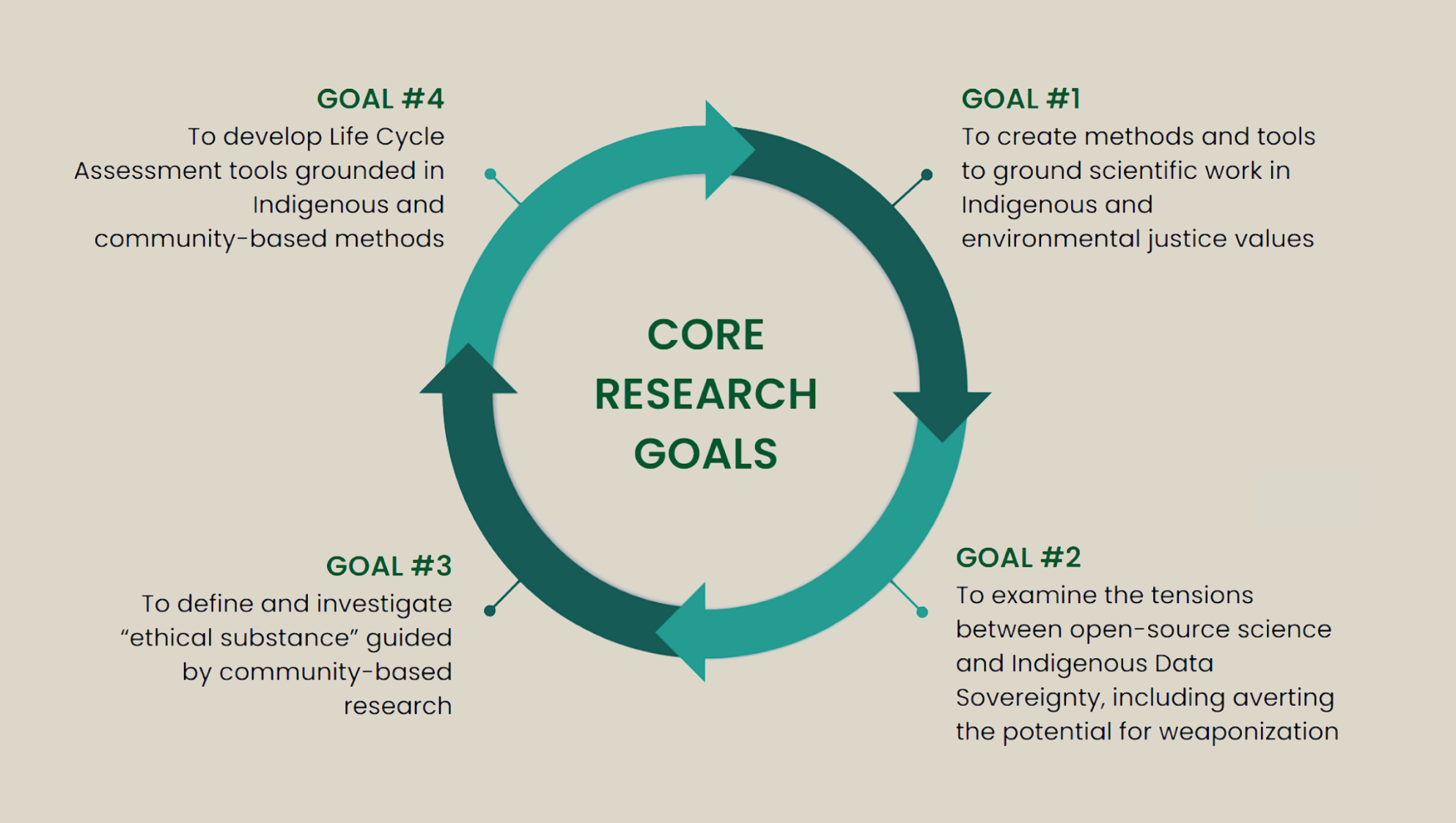
Bringing Indigenous and environmental justice value-based research methods and protocols into materials sciences and chemical research
The Indigenous Science and Ethical Substance Lab was formed in 2024 within the Technoscience Research Unit to lead transformative value-based research in material sciences, ethical substance, and chemical risk management. We conduct research guided by Indigenous ethics, practices, and science, and social justice frameworks.
As part of our core work in Indigenous Science, Technology, and Environmental Studies, we ask and seek to answer: How do we define ‘ethical substance’ and support justice-oriented materials discovery? How can Indigenous expertise and community-based methods create new practices and tools for addressing pollution and chemical risks?
This lab participates in two large projects, the first funded by a CFREF and the second by a NFRF-Transformation grant.
At the ISES lab, we promote value-based research design for the future of of materials discovery and chemical risk assessment, building on the CARE principles, community-research, and Indigenous methods. We ask: What do Indigenous research methods have to say to the use of AI in chemistry, chemical risk analysis, and toxicology? How can we in practice do research that activates Indigenous data sovereignty? How to address and prevent the weaponization of chemical research? How can Indigenous methods and community-based research change the practices of chemical risk analysis? How can we enact anticolonial and Indigenous governance processes in our environmental and scientific research practices?
Research Approaches
Community &
Land-based Research
Values-based
Research
Indigenous Data
Sovereignty
Indigenous Science
& Technology Studies

Environmental
Justice

Arts-based
Research

FEATURED PROJECTS
Research Projects
-
This research project offers a new approach to Life Cycle Assessments (LCAs). Life Cycle Assessments are tools to evaluate the impacts and processes of materials from their conceptualization to disposal and beyond. It contributes to the development of an Indigenous and Justice-based Life Cycle (IJLC) model–an exciting first-of-its-kind opportunity to bring Indigenous and justice-based research methods into ethical substance discovery.
Rooted in Indigenous relational epistemologies that center collective responsibilities towards social and environmental betterment, we aim to action sustainability and harm reduction in research design, evoke frameworks of Indigenous data governance, and incorporate community-level accessibility of use and adoption in material discovery. Our IJLC model seeks to create a practical tool for communities and scientists to assess collective benefits and potential harms, and to guide decision-making toward meaningful locally-defined transformations, justice, and sustainability.
Key features of the IJLC model include: an ethical design approach grounded in Indigenous as well as social and environmental justice frameworks that seeks to action sustainability in process and outcome; a toolkit for communities and scientists to support the application of the model; translational visuals that communicate complex ideas and processes across different audiences.
-
What is an ethical substance? What makes a substance ‘ethical’? This research project explores these questions through queer, anti-colonial, Indigenous and land-based perspectives, alongside community partnerships and art-based practices. By examining often-overlooked ethical tensions and historic and ongoing harms of substances in material discovery, we seek to foreground Indigenous and and value-based understandings of substance in material discovery.
Our research approach prioritizes collaborations with workers and communities to reimagine relationships to substances in ways that honor land, bodies, and collective well-being.
Key initiatives include: What is a Chemical? Workshops; ethical substance and Land-based and art-making practices; workers-led visions of ethical nail salons; collaboration with the Environmental Data Justice Lab and Aamjiwnaang First Nation community members on chemical risk community partnership; Critical Minerals Research with Sacred Earth.
-
This research explores and reimagines data through Indigenous perspectives centering sovereignty, ethics, and principles in our thinking on how data is accessed, governed, and used. Our work seeks to mitigate harms and address the risks that current data practices in science pose to communities and Indigenous peoples, knowledges, and lands. We ask critical questions about current data practices in open science, Open and Big Data, artificial intelligence, and data infrastructure systems: Who benefits? Who decides? What is data? How can data be transformed if aligned with Indigenous values and governance systems?
By bringing together research, teaching, and community perspectives, our research aims to shift how data is understood–not as information or neutral resource, but as deeply tied to people, land, and sovereignty.
Key initiatives include: developing curriculum on IDGov and IDS in research methodologies and Indigenous science; building capacity in Indigenous Data Sovereignty among Indigenous faculty, students, and communities; exploring intersections of Indigenous Data and AI, Data Science & Ethics, and Beyond Open Data and Big Data; Indigenous data gatherings for dialogue, relationship-building, and the co-creation of ethical data governance practices. Our work is guided by Indigenous data governance frameworks such as the CARE and OCAP, and other data governance models developed Indigenous communities locally and globally.
-
This international Indigenous-led project, funded by an NFRF Transformation Grant, builds community-based chemical risk analysis tools of use to frontline Indigenous communities and brings Indigenous methods and knowledges into chemical risk analysis and new methods of toxicological analysis.

EVENTS
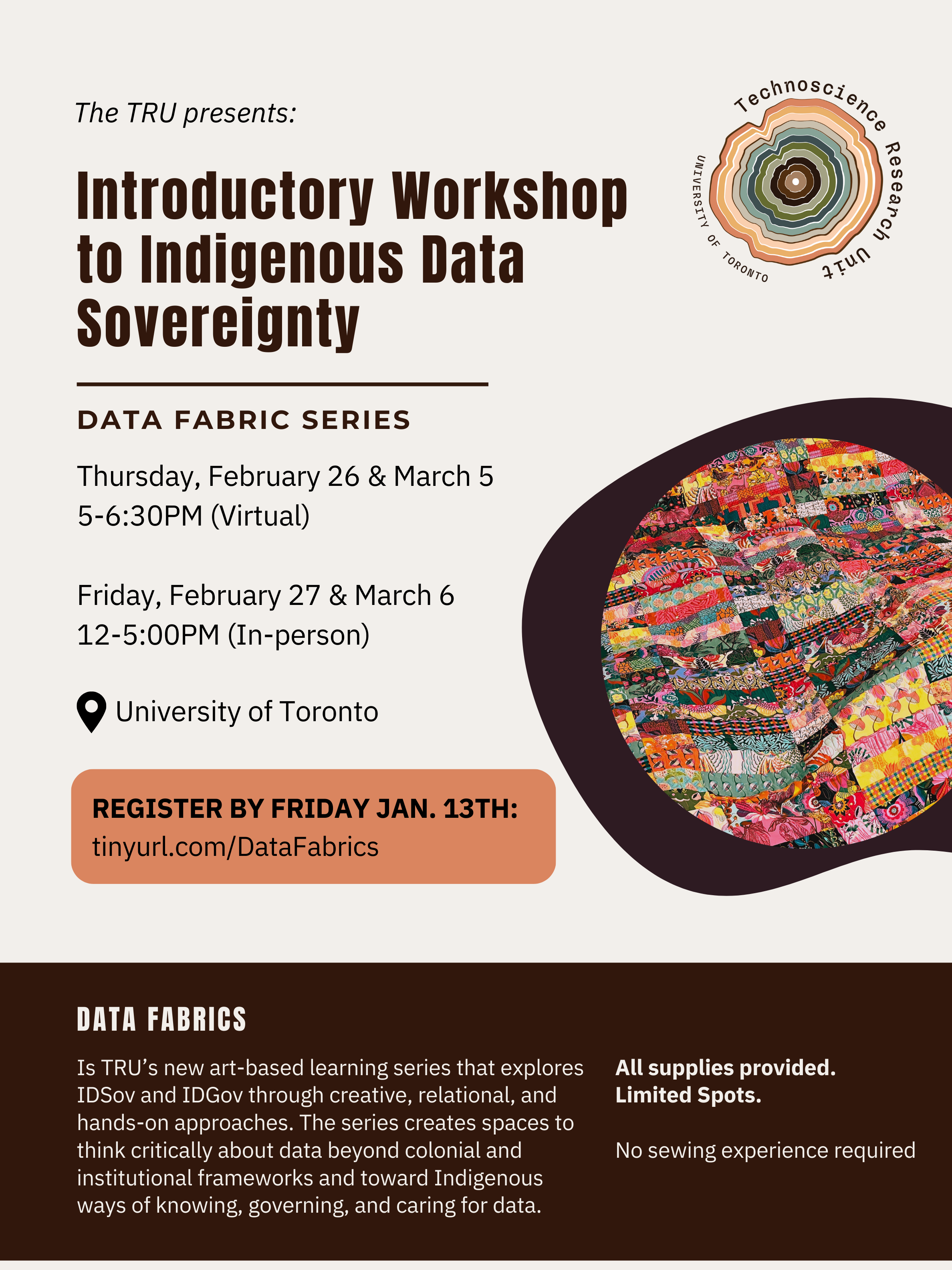
Data Fabrics Series
Data Fabrics is an art-based learning series that explores Indigenous Data Sovereignty and Governance through creative, relational, and hands-on approaches. The series creates spaces to think critically about data beyond colonial and institutional frameworks and toward Indigenous ways of knowing, governing, and caring for data.
Across workshops, Data Fabrics brings together discussions, readings, art-making, and reflections to support participants in engaging with data as relational, contextual, and embedded in lands, communities, and responsibilities. Each workshop in the series focuses on a different aspect of data using creative practices as tools for learning, sense-making, and reimagining data futures.
Introduction To Indigenous Data Sovereignty
This workshop is the first offering in the Data Fabrics series. It provides foundational concepts and shared language for understanding Indigenous data, while inviting participants to think about data through the craft of sewing and quilting.
This introductory workshop brings together virtual learning and sewing to explore what Indigenous data is, why conceptualization of data matters, and what it means for Indigenous communities to assert governance and sovereignty over data.
Participants will engage with key readings and passages, guided discussions, and creative practice to reflect on data. Quilt-making is used as a method to think about data, knowledge systems, and governance frameworks; how pieces come together, how relationships are formed, and how meaning is held.
No prior knowledge on data or quilting is required.
-
Through this introductory workshop, participants will:
Learn what constitutes Indigenous data and how it differs from Western and colonial institutional notions of data
Understand key concept and distinctions between IDSov and IDGov
Become familiar with Indigenous data governance frameworks
Explore Indigenous concepts through sewing and quilting as hands-on practice
-
This introductory workshop will take place over two weeks and includes:
2 virtual sessions (two hours each)
Focused on foundational concepts, reflections, and group discussion
2 in-person, hands-on sewing and quilting sessions (five hours each)
Focused on creative making, conversations, and collaborative learning
All quilting materials will be provided. Lunch and snacks will be included during in-person sessions.
No sewing or quilting experience is necessary.
Participants who complete this workshop will receive a gift certificate to a quilting store.
-
This introductory workshop is open to Indigenous undergraduate or graduate students from any institution who are interested in or working on Indigenous research, data, governance, art-based methods, practices, and pedagogies.
Participation is limited to support a small collaborative learning environment.
Dates And Registration:
• Thursday, February 26, 5-6:30pm (virtual)
• Friday, February 27, 12-5:00pm (in-person)
• Thursday, March 5, 5-6:30pm (virtual)
• Friday, March 6, 12-5:00pm (in-person)
Registration is required!
For more information, please contact: fernanda.yanchapaxi@mail.utoronto.ca

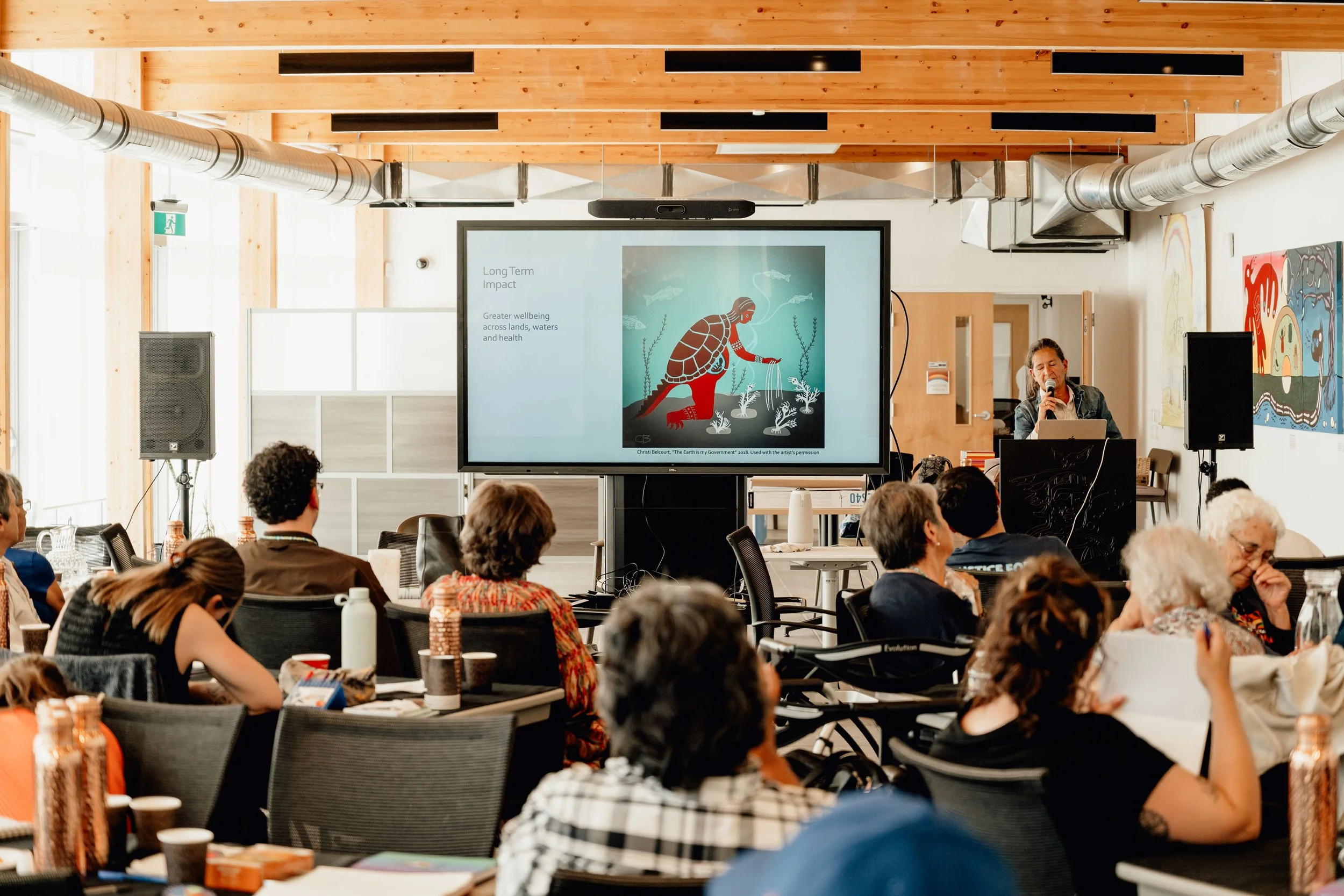
The Indigenous Science and Ethical Substance Lab collaborates with global academic communities, Indigenous-led organizations, and community organizations to conduct training, research, advocacy, and policy change.
Acceleration Consortium
The ISES lab collaborates with Acceleration Consortium–a global community of academia, industry, and government that brings together artificial intelligence (AI), robotics, material sciences, and high-throughput chemistry to create self-driving laboratories (SDLs). Autonomous labs rapidly design materials and molecules needed for a sustainable, healthy, and resilient future, with applications ranging from renewable energy to drugs. A mandate of the AC is to ensure that all materials and technologies are ethically designed, create sustainable materials, and engage with community-based and Indigenous knowledges. Some of the ISES-AC research collaborations include: establishing valued-based guidelines for SDLs; creating rubrics for partnership development; deepening the understanding of ethical and social dimensions of and implications of accelerated materials discovery.
The TRU strives to ensure the ethical integration of Indigenous knowledges and values into research design for materials discovery. This includes proceeding with care and reciprocity, accounting for intergenerational impacts, and drawing on relational frames to undergird environmental sustainability.
The Nail Salon Workers' Project, Parkdale Queen West Community Health Center
The Indigenous Science & Ethical Substance (ISES) lab collaborates with the Nail Salon Workers' Project (NSWP), a program at Parkdale Queen West Community Health Centre. The NSWP aims to learn about and reduce the negative health impacts of working in nail salons and advocate for healthy and just work environments for nail technicians. Areas of focus for the program include training and capacity building; research, policy change, and advocacy; partnership building; and, program development.
The collaboration with ISES includes participation in the Healthy Nail Salon Coalition, as well as mutually-defined work towards ethical nail products and nail salon-based life cycles.
Sacred Earth
Sacred Earth is an Indigenous women-led organization dedicated to advancing a just transition for Indigenous communities aiming to reduce dependency on fossil fuels and build resilience in the face of climate change.
The Indigenous Science and Ethical Substance Lab is collaborating with Sacred Earth to support research on understanding the role and impact of critical minerals for the energy transition, and the relationship between critical minerals and Indigenous Peoples. This research includes the stages to renewable energy development throughout the full life cycle, including the extraction and re-use of critical minerals.
The ISES research projects are funded and supported by:
Canada First Research Excellence Fund (CFREF) - Acceleration Consortium
New Frontiers in Research Fund - NFRF