
Indigenous Science, Technology & Environmental Studies (ISTES)
Indigenous contributions to science, technology, and environmental studies signal a new era of research collaboration.
THE LAB
Indigenous contributions to science, technology, and environmental studies (STES) signal a new era of research collaboration.
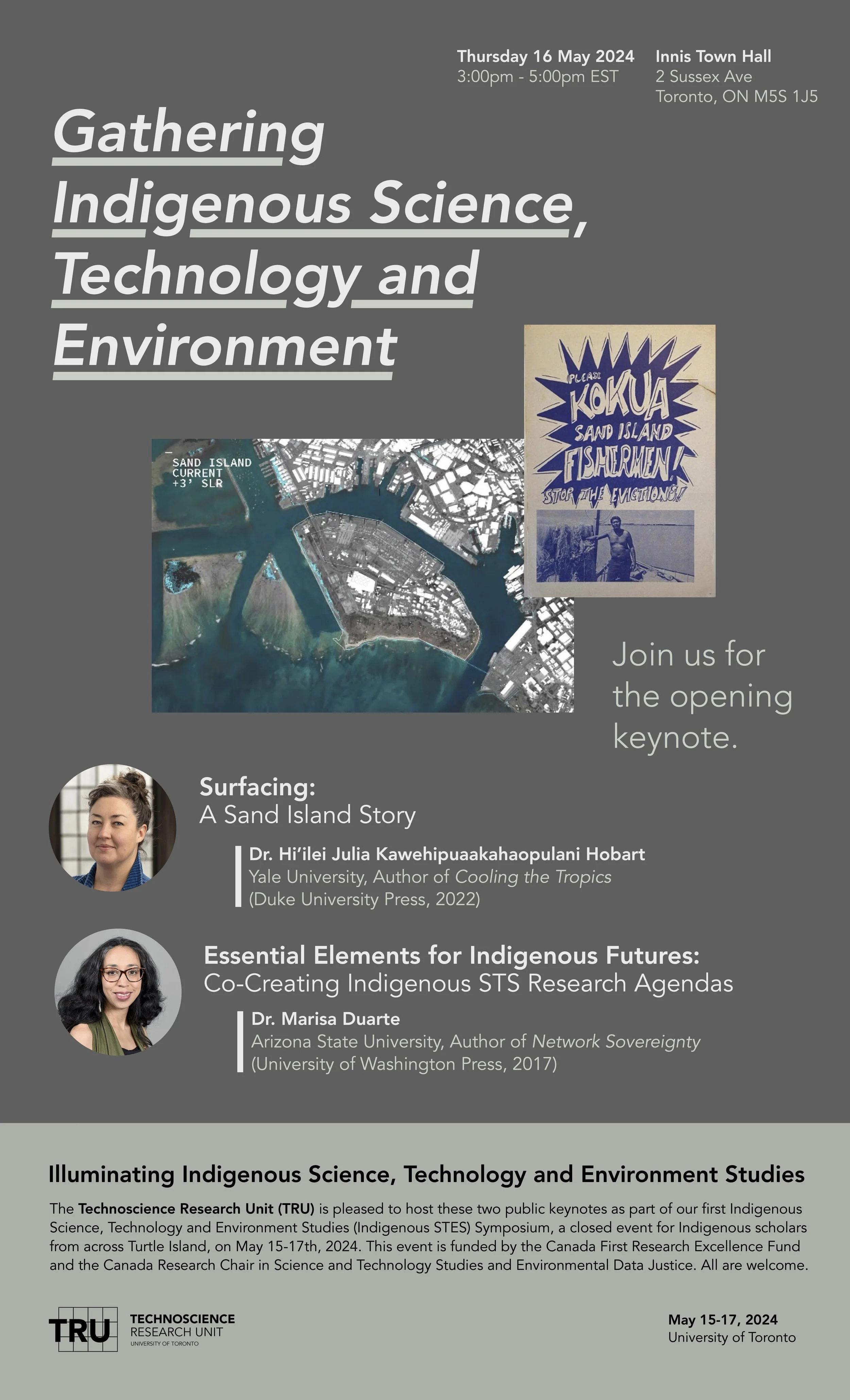


Fields as distinct as chemistry, AI, and pharmacy now seek to collaborate with Indigenous scholars. At the same time, Indigenous scholars are taking the lead in developing their own methods of Indigenous research suited to data and computationally driven research conditions, current and future technologies, and urgent environmental needs while transforming policies, protocols, and practices that support self-determination.
Indigenous Science, Technology, and Environmental Studies (ISTES) is a recent field of research in which we are building strength in at the University of Toronto. ISTES scholars are leading the development of Indigenous research methods to evaluate, engage, and innovate in scientific, technological, and environmental research practices. Some ISTES scholars are designing Indigenous approaches to chemicals risk management (Ataria et al. 2023), exploring how traditional Indigenous land management and stewardship practices can inform AI-driven land management and restoration systems (Lewis et al. 2020), and foregrounding Indigenous intergenerational knowledge of weather, water, and land as crucial to both the understanding of historical climate changes and the shaping of healthy future lifeways (Leonard et al. 2023).
Indigenous STES research undertakes science, technology, and environmental research differently, drawing forward traditional forms of knowledge and practice, as well as commitments to community service, into technical work. Indigenous research requires distinct methods of consultation, community-based research, data sovereignty, traditional teachings, and arts-based mixed methods. And, the Technoscience Research Unit is committed to advancing the research in the field of ISTES at the University of Toronto and globally.
At present, there are growing Indigenous STS/STES centers and labs worldwide. Where infrastructure exists, lab-based models are followed. As such, TRU thinks of ISTES not as an individual researcher’s agenda or a lab’s research program but rather as a collective of infrastructures and people behind a persistent question of how much more we achieve if we share infrastructure while we train ourselves and our students across disciplinary and geographic boundaries.

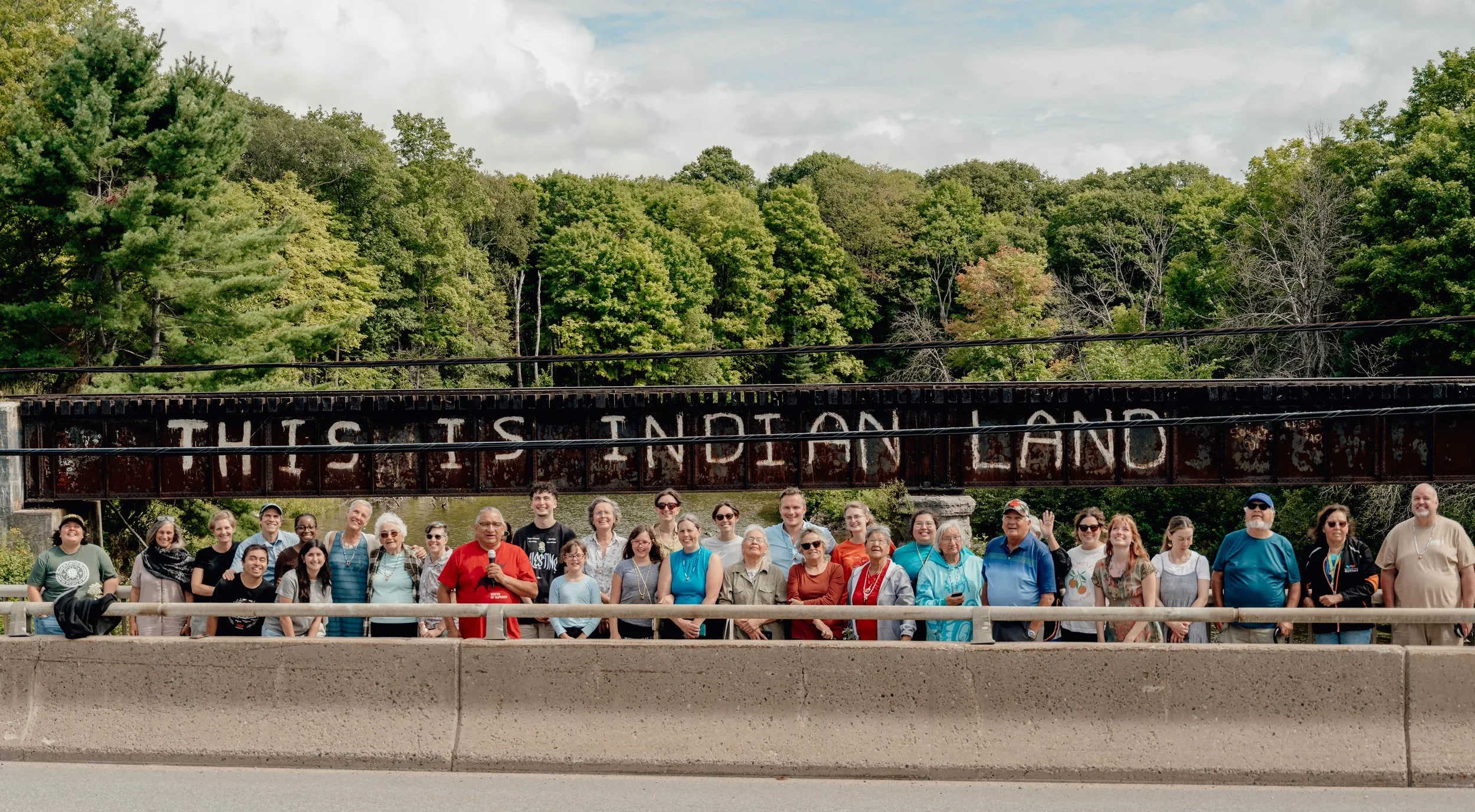
ISTES Research Hub
The ISTES Research Hub is envisioned as a foundational hub where researchers within and beyond Canada can collectively build and accelerate our individual and collective research activities. The Hub was created to address the unique needs of Indigenous STES researchers while creating sustainable infrastructure that will:
1
Materially and informationally advance emergent, current, and future Indigenous research in the field of STES;
2
Nurture Indigenous methods, values, and knowledges in ways that expand and transform STES within and beyond Canada, and;
3
Cement the University of Toronto as a global Indigenous STES hub.
The ISTES Research Hub upholds the imperative and timely need to support the growth of Indigenous ISTES as represented in the expanding numbers of current and emergent Indigenous researchers at the University of Toronto, who bring their original, innovative, and transformational research activities and students to the Hub. The Hub promotes Indigenous-led governance models as part of research methods; emphasizes the training of emergent, current, and future Indigenous STES leaders; and houses Indigenous STES research projects that respond to pressing research problems and epistemic and methodological questions of fields as diverse as chemistry, AI, pharmacy, and medicine.
The Hub provides equipment to nurture Indigenous methods, tools, values, and knowledges to expand and transform Indigenous STES within and beyond Canada; promotes enacting and materializing the principles of Indigenous Data Sovereignty; supports expanding Indigenous STES collaborations at the local, regional, national, and international levels to facilitate knowledge exchange and real-world impact; and aims to train future generations of Indigenous STES scholars.
Some of the questions we consider at the Hub are: How do we practice epistemological diversity? How do we foreground intergenerational and Indigenous knowledge of the environment in our research activities? How can Indigenous communities be part of scientific projects without extractive effects? How do we advocate, design, and build towards Indigenous self-determination and sovereignty in STES? How do we store and manage our data?
The Hub is physically located on the 10th floor of the Ontario Power Building at 700 University Ave, in Toronto. The Hub is proximate to two intersecting units: the Data Studies Institute and the Acceleration Consortium. Its infrastructure includes collective working and meeting tables, arts equipment, printing equipment, and storage, computers and monitors, software, servers, and projectors. The Hub can host large workshops necessary to build and grow the field.
The ISTES Lab is led by M. Murphy, Kristen Bos, and Fernanda Yanchapaxi.

FUNDING
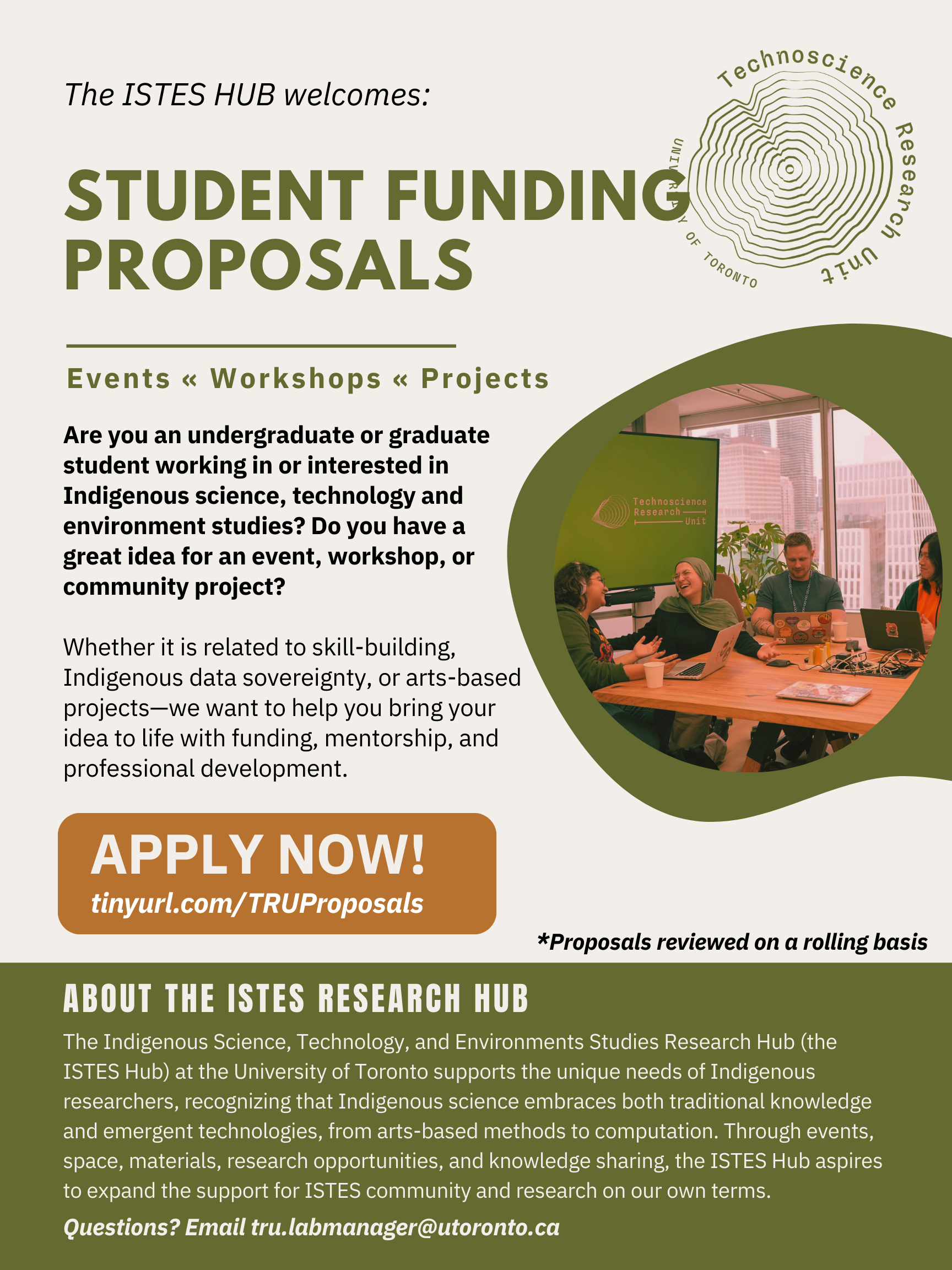
Student Funding Proposals
The ISTES Hub welcomes proposals from undergraduate or graduate students working in or interested in Indigenous science, technology and environment studies. We are currently accepting proposals for student-led events, workshops, or community projects.
Successful proposals will receive financial support, mentorship, and opportunities for skill-building and professional development. We review proposals on a rolling basis!
If you have any questions, please email tru.labmanager@utoronto.ca